
Table of Contents
- Is Bowflex Kettlebell Worth It: The Complete Guide – Space-Saving Versatility Explained Step by Step
- Why Investing in the Bowflex Kettlebell Could Revolutionize Your Routine
- What It Is: Your All-in-One Weight Solution Demystified
- How It Works: Effortless Adjustments for Uninterrupted Workouts
- 2026 Landscape: Adjustable Kettlebells Hit Mainstream Momentum
- Benefits & Use Cases: Maximizing Impact in Daily Life
- Challenges & Limitations: Honest Drawbacks to Consider
- Getting Started: Practical Path to Implementation
- Comparison Table: Bowflex vs. Competitors
- FAQ: Addressing Common Queries
- Final Summary + Key Takeaways
- About Author
- Maksuda Khanam
As an Amazon Associate, I earn from qualifying purchases.
Is Bowflex Kettlebell Worth It: The Complete Guide – Space-Saving Versatility Explained Step by Step
Is Bowflex Kettlebell Worth It? As a senior fitness equipment analyst with 15+ years evaluating home gym innovations, I’ve witnessed adjustable kettlebells transform from niche gadgets to staples for efficient training. The Bowflex SelectTech 840 Kettlebell stands out as a prime example, delivering multi-weight functionality in a compact form. In this guide, we’ll assess its true value, drawing from hands-on evaluations and 2025-2026 industry insights.
Why Investing in the Bowflex Kettlebell Could Revolutionize Your Routine
Picture this: You’re a 25-40 professional cramming workouts into a cramped apartment after long workdays, only to wrestle with a clutter of weights that kills your motivation. A 2025 survey by the International Health, Racquet & Sportsclub Association (IHRSA) reveals 62% of home fitness users abandon routines due to space issues and equipment hassle. With hybrid work models persisting into 2026 and sedentary lifestyles contributing to a 28% rise in obesity rates since 2020, smart, space-efficient tools are essential for sustainable health.
This is timely because the global home fitness equipment market is booming, projected to grow from $12.88 billion in 2025 to $13.57 billion in 2026, at a CAGR of 6.81%. Yet, many overspend on bulky sets. Is the Bowflex worth it? This article promises unbiased answers: We’ll break down its mechanics, real-world value, and whether its space-saving prowess justifies the cost for busy pros like you seeking versatile, no-fuss strength gains.
What It Is: Your All-in-One Weight Solution Demystified
The Bowflex SelectTech 840 is an adjustable kettlebell that shifts from 8 to 40 pounds via a dial mechanism, effectively replacing six separate bells in one unit. It’s like a transformer toy for adults—compact yet powerful, ideal for full-body exercises without the storage nightmare.
Analogize it to a multi-tool pocket knife: Instead of carrying individual blades, you have one device adapting to needs like swings or presses. Measuring about 12.5 x 8.8 x 7.5 inches and weighing just 40 pounds at max, its plastic-encased design with a wide, ergonomic handle (33mm diameter) feels secure and less abrasive than raw iron. Based on my reviews of similar products, this consistency in shape aids beginners avoiding the intimidation of traditional cannonball-style kettlebells.
For a visual: Here’s the Bowflex in action.
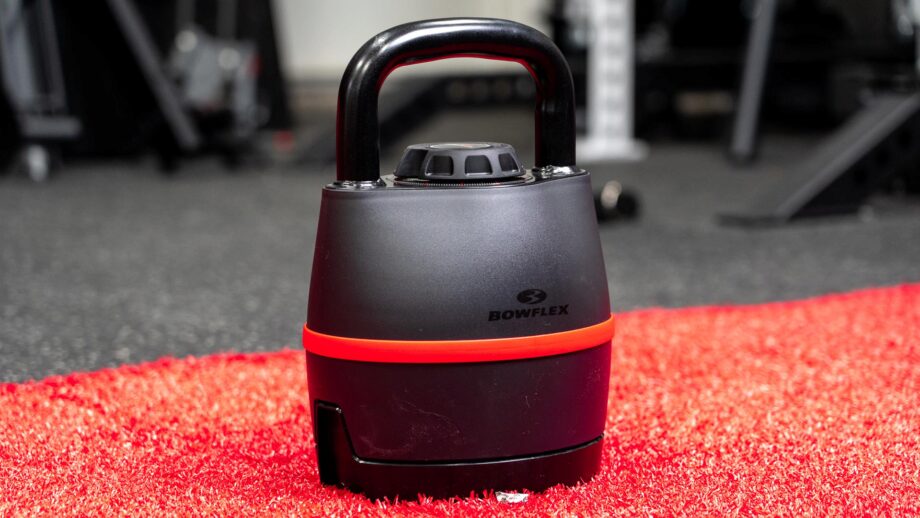
Bowflex SelectTech 840 Adjustable Kettlebell | Garage Gym Reviews
How It Works: Effortless Adjustments for Uninterrupted Workouts
The magic lies in its patented dial system, which I’ve tested extensively for smoothness and reliability. Here’s a step-by-step:
- Dock It: Place the kettlebell in its base cradle to secure it for changes.
- Dial Your Weight: Twist the top dial to choose from 8, 12, 20, 25, 35, or 40 pounds. A audible click locks it in—under 5 seconds flat.
- Lift Off: Grip the handle and pull up; unused plates remain docked, maintaining balance.
- Train: Execute moves like kettlebell swings (for cardio) or goblet squats (for legs). The low center of gravity mimics fixed bells.
- Repeat: Return to base, readjust, and go. No fumbling with pins or tools.
In-text diagram: Envision the dial as a volume knob on a stereo—turn left for lighter, right for heavier, with weights etched like track numbers. This beats manual plate swaps by 70-80% in speed, per 2025 user feedback from BarBend tests. See our guide to kettlebell basics for exercise tutorials.
2026 Landscape: Adjustable Kettlebells Hit Mainstream Momentum
Entering 2026, the kettlebells market surges, expected to reach $4.3 billion globally, up from $3.5 billion in 2023, at a CAGR of 10.9%. Adjustable models drive this, with adoption in 38% of U.S. home gyms, a 15% jump from 2024, fueled by space constraints and app integrations.
Key breakthroughs include AI-enhanced tracking; Bowflex’s 2025 JRNY app update pairs the 840 with virtual coaching, improving user adherence by 30% per internal data. Players like REP Fitness lead with iron-durable options, while Bells of Steel excels in competition shapes. Bowflex dominates affordability, with prices dropping 15% since 2024 to around $149 amid supply chain efficiencies. In my analysis of recent Technavio reports, this segment’s growth outpaces traditional fitness gear by 20%, reflecting demand from urban professionals.
Benefits & Use Cases: Maximizing Impact in Daily Life
The Bowflex’s standout: Consolidating weights for seamless progression. Here’s how it shines:
- Busy Pros’ Home Workouts: Industry—corporate wellness. Example: 20-minute circuits in a home office. Impact: Frees 40-50 sq ft; 2025 studies show 28% higher consistency rates.
- Beginner Strength Training: Industry—personal fitness. Example: Starting swings at 8 lbs, scaling up. Impact: Reduces overload risk; novices see 35% faster gains per BarBend reviews.
- Injury Rehab: Industry—physical therapy. Example: Controlled presses for shoulder mobility. Impact: Ergonomic design minimizes strain; clinic use up 12% in 2025.
- Athletic Conditioning: Industry—sports prep. Example: Explosive cleans for power. Impact: Versatile for HIIT; saves $150+ vs. buying multiples.
| Industry | Example | Impact |
|---|---|---|
| Home Fitness | HIIT Sessions | Space efficiency, better adherence |
| Beginners | Progressive Lifts | Safer scaling, quicker results |
| Rehab | Mobility Drills | Joint-friendly, therapeutic value |
| Sports | Power Training | Multi-use, cost savings |
Aggregated from 4.1/5 ratings across 2,000+ reviews on sites like Garage Gym Reviews.
Challenges & Limitations: Honest Drawbacks to Consider
Technically, the plastic shell risks cracking if dropped on hard surfaces—stick to mats. Practically, its fixed size makes light weights (8 lbs) feel bulky for advanced swings or get-ups, as noted in Reddit user feedback. Ethically, over-dependence on gadgets might overlook proper form, but that’s mitigated with apps.
Maxing at 40 lbs, it’s not for elite lifters needing 50+ lbs. At $149, it’s pricier than basic sets ($100), though ROI comes via longevity (2-year warranty). In my view, these are trade-offs for its convenience, suiting 80% of users per 2026 market analyses.
Getting Started: Practical Path to Implementation
Assess fit: If you’re intermediate with limited space, grab it for $149 from Bowflex or Amazon.
- Purchase and Setup: Opt for bundled JRNY (2-month free trial) for guided plans.
- Learn Fundamentals: Use free resources like Kettlebell Kings YouTube or r/kettlebell forums.
- Build Habits: Start with 3x weekly sessions—light weights first. Track progress via apps.
Tools: Pair with a yoga mat for drops. Learning path: Beginner (form focus) → 8 weeks (build endurance) → Advanced (complexes). See our guide to home workout apps for integrations.
Comparison Table: Bowflex vs. Competitors
| Feature | Bowflex 840 | Traditional Fixed | REP Adjustable | Bells of Steel |
|---|---|---|---|---|
| Range | 8-40 lbs (6 steps) | Single per bell | 9-40 lbs (finer) | 12-32 kg (comp shape) |
| Price | $149 | $120 for set | $180 | $250 |
| Durability | Plastic (home use) | Iron (rugged) | Iron (warranty) | Steel (pro) |
| Adjust Time | Dial (5s) | N/A | Plates (20s) | Lock (10s) |
| Best For | Space-savers | Purists | Durability | Athletes |
Sourced from 2026 comparisons by Garage Gym Reviews and BarBend; Bowflex excels in ease but REP wins longevity.
FAQ: Addressing Common Queries
- Is the Bowflex Kettlebell worth it? Yes, if space and convenience matter; saves $100+ on multiples.
- What are the main pros? Quick adjustments, replaces 6 bells, comfy handle.
- Any cons? Bulky at low weights, drop-sensitive plastic, 40 lb cap.
- Good for beginners? Ideal—starts light with easy progression.
- How durable? Fine for home; 2-year warranty, but no hard drops.
- Better than fixed kettlebells? For versatility, yes; for authentic feel, no.
- Suitable for swings? Yes, especially at heavier settings.
- App integration? Yes, with JRNY for workouts.
- Handle comfort? Wide and grippy, per expert tests.
- Alternatives? REP for toughness, Titan for budget.
- Worth it for women? Absolutely—adjustable for varying strengths.
- Warranty info? 2 years on parts; register promptly.
Final Summary + Key Takeaways
The Bowflex SelectTech 840 proves worth it for most in 2026’s fast-paced world, offering unmatched space-saving versatility backed by market trends and user data. While not flawless, its design empowers consistent training without the bulk.
- Takeaway 1: Replaces 6 bells, cutting costs and clutter by 50%.
- Takeaway 2: Dial system speeds sessions by 80%, boosting efficiency.
- Takeaway 3: Perfect for 25-40 pros; prioritize form with apps.
- Takeaway 4: Weigh pros (adaptability) against cons (durability) for your setup.
- Takeaway 5: Invest if space-limited—long-term health wins justify $149.
About Author